Steamfitters and pipefitters build the piping that carries steam, water, gas and process fluids. Here are a few of the people and events behind steam systems and the rules that keep them safe.
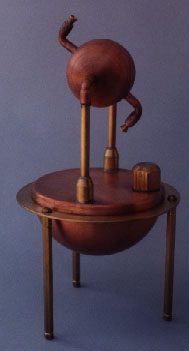
An aeolipileKatie Crisalli, Unknown. Public domain. Wikimedia Commons. Image source
Hero of Alexandria's spinning ball
1st century CE · Hero of Alexandria
Hero of Alexandria was a Greek-Egyptian mathematician and engineer who lived in the first century CE. He wrote about many machines, from pumps to temple doors that seemed to open by themselves.
One of his best-known descriptions is the aeolipile, sometimes called Hero's engine. Water is heated in a closed vessel. The steam travels up through pipes into a ball that can turn on its axis. Bent nozzles stick out of the ball on opposite sides. Steam shoots out of the nozzles and pushes the ball around.
The name means the ball of Aeolus, the Greek god of the wind. The Roman writer Vitruvius had described a similar device a little earlier, so Hero may not have invented it.
The aeolipile was a toy, not a practical source of power, and it did not lead straight to the steam engines of the 1700s. But it shows two ideas fitters still work with: steam under pressure carries energy, and where it leaves a nozzle it pushes back. The US Navy even used the aeolipile as the badge of its boiler ratings.
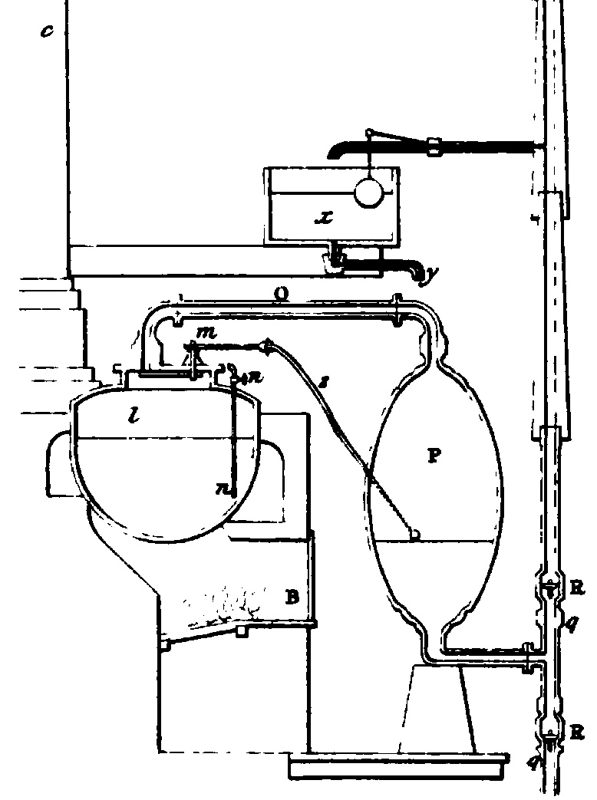
Savery's steam engine, from his book The Miner's FriendThomas Savery, 1702. Public domain. Wikimedia Commons. Image source
Thomas Savery's Miner's Friend
1698 to 1702 · Thomas Savery (about 1650 to 1715)
Thomas Savery was a military engineer from Devon, England, who spent his spare time on mechanical experiments. Mines in England were flooding as they went deeper, and getting the water out was a big problem.
On 2 July 1698 Savery patented a steam-powered pump. Steam filled a closed vessel. Cooling the vessel condensed the steam and made a partial vacuum, which drew water up a pipe. Then fresh steam pressure pushed the water higher, out of the vessel. Valves kept the water moving the right way.
He showed the machine to the Royal Society in 1699. In 1702 he described it in a book called The Miner's Friend, or An Engine to Raise Water by Fire. An Act of Parliament extended his patent, and it was so broad that it covered all pumps that raised water by fire.
Savery's engine used steam at pressure in vessels and pipes with little control, and it had real limits. But it put steam, vacuum, check valves and piping together in one working system, something every steamfitter still deals with.
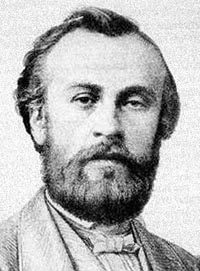
Henri GiffardUnknown author, 19th century. Public domain. Wikimedia Commons. Image source
Henri Giffard's injector
1852 to 1858 · Henri Giffard (1825 to 1882)
Henri Giffard was a French engineer born in Paris in 1825. He is famous for two very different inventions. In 1852 he flew the first powered, steerable airship, using a small steam engine. He also invented the steam injector.
A boiler under pressure needs a steady supply of feedwater, and pumping water into it against that pressure takes work. Giffard found a clever way. Steam from the boiler blasts through a cone-shaped nozzle and picks up speed. It mixes with cold water, condenses, and the fast-moving jet of water has enough momentum to push past a check valve into the boiler.
Unusually, Giffard worked out the theory before he built one. He was granted a French patent for the injector in 1858. It was quickly put to work on steam locomotives, and British rights went to Sharp, Stewart and Company of Glasgow.
Injectors have no pistons or rotating parts, so there is little to wear out. Steam ejectors and eductors used on piping systems today work on the same jet principle.
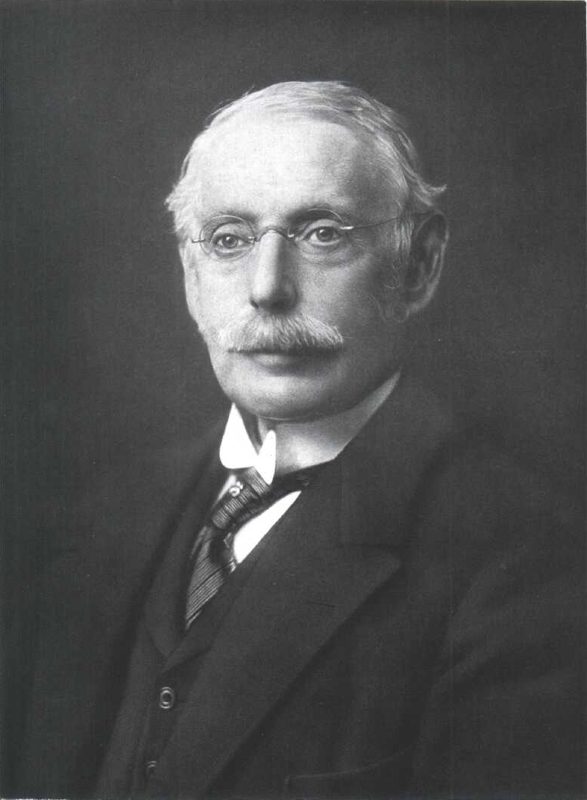
Charles Algernon ParsonsUnknown author, Unknown. Public domain. Wikimedia Commons. Image source
Charles Parsons spins a steam turbine
1884 to 1897 · Sir Charles Algernon Parsons (1854 to 1931)
Charles Algernon Parsons was an English engineer. In 1884 he joined Clarke, Chapman and Company, a ship-engine maker near Newcastle, as head of electrical equipment development.
Piston steam engines were slow and shook a lot, which made them a poor match for electric generators. That year Parsons designed a compound steam turbine. Instead of using all the steam's energy in one step, it let the steam expand through many rows of blades, a bit at a time. His first turbine ran at 18,000 revolutions per minute and drove a generator he also designed.
By 1888 about 200 Parsons turbo-generators were in service, mostly lighting ships. In 1897 his turbine-powered boat Turbinia showed up unannounced at a naval review and raced past the fleet at 34 knots.
Steam turbines went on to drive warships, ocean liners and most of the world's power stations. Building and maintaining the high-pressure steam, condensate and feedwater piping around turbines is major work for steamfitters and pipefitters.
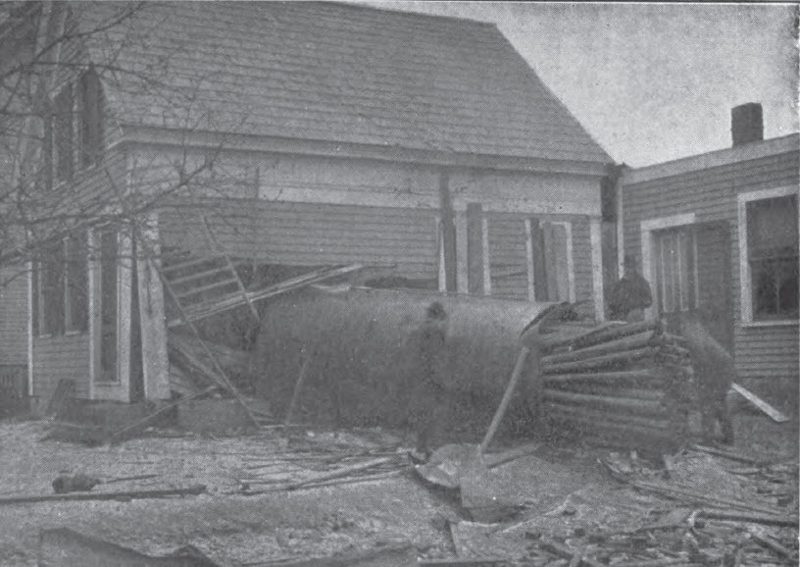
The boiler after the Grover shoe factory explosion, 1905Abert F. Pierce, History of the Brockton Relief Fund, 1905-03. Public domain. Wikimedia Commons. Image source
The Grover explosion and the boiler code
1905 to 1915 · Workers of the R. B. Grover shoe factory and the ASME
In March 1905 the R. B. Grover shoe factory in Brockton, Massachusetts, was heated with steam from coal-fired boilers. The new boiler was down for cleaning, so an older backup boiler was put back into service early one morning.
Shortly before 8 a.m. the old boiler exploded. It shot up through three floors and the roof. The four-storey wooden building collapsed and caught fire, trapping workers inside. Fifty-eight people died and many more were injured.
Boiler explosions were common at the time, but Grover shocked the public. Massachusetts formed a Board of Boiler Rules, and in 1907 it passed a law on the operation and inspection of steam boilers.
The American Society of Mechanical Engineers then wrote a national code. The first ASME Boiler and Pressure Vessel Code, the 1914 edition, was published in 1915 and had 114 pages. Canadian provinces also adopt rules for boilers and pressure piping. When a steamfitter follows a welding procedure, uses certified materials or has a system inspected, it traces back to disasters like Grover.