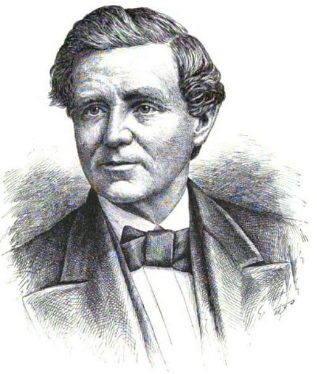
Henry Disston, from an 1896 publicationUnknown author, 1896-01-01. Public domain. Wikimedia Commons. Image source
Henry Disston builds a saw works
1833 to 1878 · Henry Disston (1819 to 1878)
Henry Disston was born in Tewkesbury, England, in 1819. At 14 he sailed to America with his father and sister. Three days after they reached Philadelphia, his father died suddenly, and the boy had to find work.
He was taken on as an apprentice by a local saw-making firm, Lindley, Johnson and Whitcraft. There he learned the saw-making trade. In 1840 he left to start his own saw-making business.
His saws earned a strong name. By 1850 they were being compared with English saws, which many buyers then thought were the best. Disston brought skilled workers over from England, and by 1859 about 150 people worked for him.
In 1871 the business had outgrown its shop and moved to Tacony, on the edge of Philadelphia, beside the railway and the Delaware River. Disston built houses for his workers there. The company, later Henry Disston and Sons, became the top maker of hand saws in the United States in the late 1800s and early 1900s. Many filers still come across old Disston saws today.
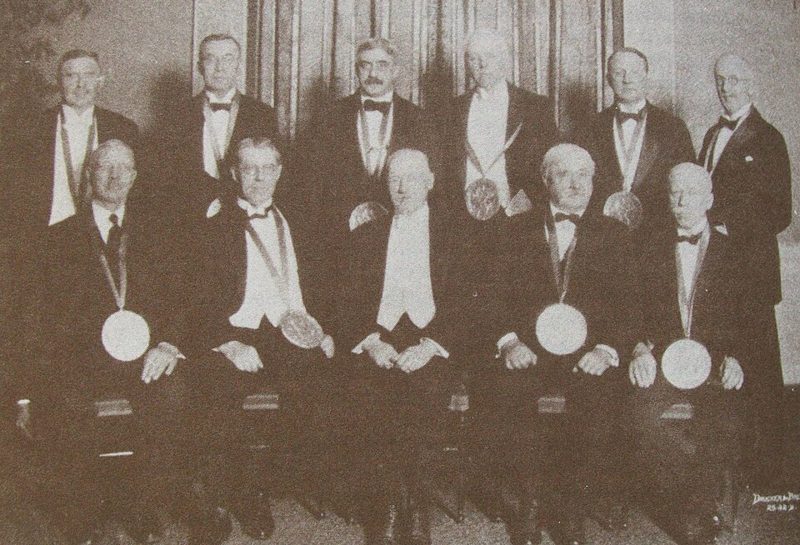
Elwood Haynes, about 1925Unknown author, 1925-01. Public domain. Wikimedia Commons. Image source
Elwood Haynes and the hard alloy
1907 to 1912 · Elwood Haynes (1857 to 1925)
Elwood Haynes of Kokomo, Indiana, was an inventor, metallurgist and early car builder. While looking for metals that would not rust or stain, he made a new alloy of cobalt and chromium. He called it Stellite.
Haynes patented his first Stellite alloys in 1907. He kept experimenting and was granted more patents in 1912. That same year he founded the Haynes Stellite Company in Kokomo to make the metal.
Stellite turned out to be very hard. It holds a cutting edge at high temperature and resists wear and corrosion. Demand was strong during the First World War for cutting tools and machine tools. In 1920 Haynes merged his company with Union Carbide.
Stellite alloys are a whole family today, with cobalt and large amounts of chromium and often tungsten. Their hardness and wear resistance are why the name still comes up in sawmills. Tipping saw teeth with a hard alloy, and then grinding those tips to shape, is a job many saw filers know well.
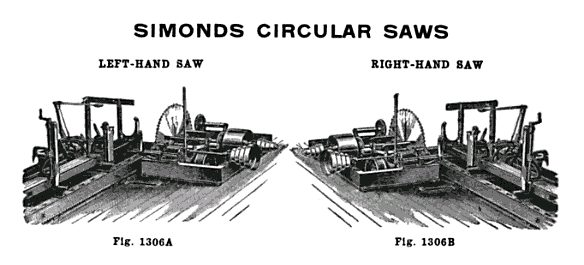
A circular mill saw shown in a 1905 sawmill catalogueCameron & Barkley Company, 1905. Public domain. Wikimedia Commons. Image source
The big circular saw comes to the mill
1777 to the 1800s · Samuel Miller and Tabitha Babbitt (1779 to 1853)
Before power saws, logs were often cut by hand with a pit saw. One sawyer stood on top of the log and one stood in a pit below, pulling a long blade up and down. It was slow, hard work.
Who invented the circular saw is still argued about. A sailmaker named Samuel Miller of Southampton, England, got a patent in 1777 for a saw windmill, but the patent only mentions the round saw in passing. In the United States, the Shakers credited Tabitha Babbitt of Harvard, Massachusetts, with a circular saw for lumber around 1813, after she noticed that a pit saw only cut on one stroke. Historians now mostly doubt that claim.
What is clear is that after about the 1820s, mills began to use large circular saws, some up to 3 metres across. They needed more power than up-and-down saws, so they did not really take off until steam engines drove them.
Big mill saws have to be tensioned and benched so they run true at speed. Some have replaceable inserted teeth. Keeping them flat, round and sharp is classic saw filer work.
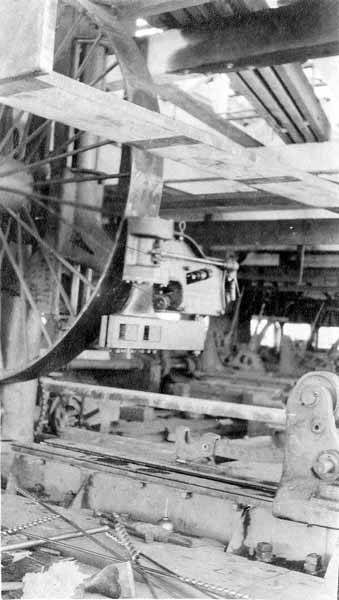
A band saw guide in a sawmill, about 1910Unknown author, circa 1910. Public domain. Wikimedia Commons. Image source
Anne Paulin Crepin makes the band saw work
1808 to 1846 · William Newberry and Anne Paulin Crepin
A band saw uses a long steel blade joined into a loop and run over two big wheels. The idea is old. William Newberry of London received a British patent for a band saw in the early 1800s.
For decades the idea did not work well. Every turn over the wheels flexed the blade. Either the steel cracked or the joint that closed the loop broke. Nobody could make a blade that was both accurate and tough enough.
In 1846 a Frenchwoman, Anne Paulin Crepin, applied for a patent on a new way of welding the blade into a loop. She soon sold the right to use it to A. Perin and Company of Paris. Perin combined her joint with better steel and tempering and made the first modern band saw blade.
Today big band mills run blades on wheels large enough to limit metal fatigue. The blades are stretched very tight and have tension worked into them so they stay straight while hot and fast. They also have to come off and be serviced on a schedule. That is the daily work of saw filers, sometimes called saw doctors.
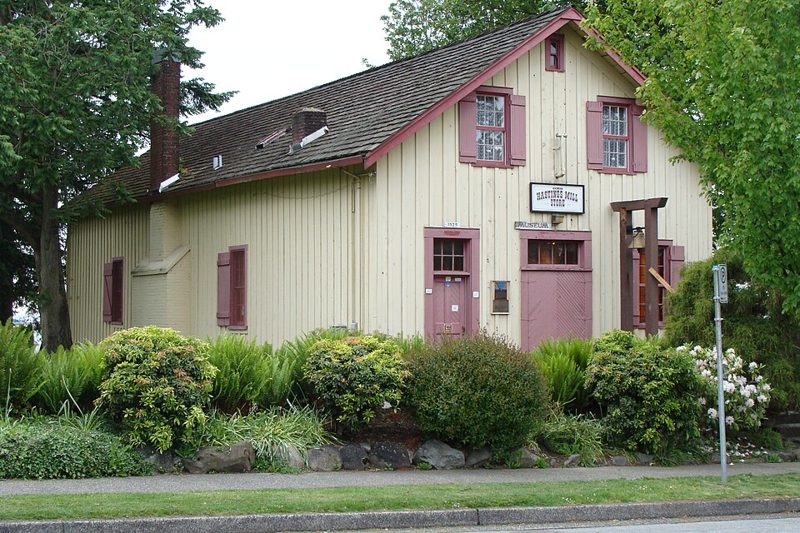
The Old Hastings Mill Store, now a museum in VancouverIota 9 at en.wikipedia, 2010. CC BY-SA 3.0. Wikimedia Commons. Image source
Hastings Mill and the start of Vancouver
1865 to 1928 · Captain Edward Stamp and the mill crews
In 1865 Captain Edward Stamp formed a company in England to cut lumber in British Columbia. He won the right to buy or lease a large area of coastal timber and picked a mill site on the south shore of Burrard Inlet.
Machinery parts were slow to arrive from England, so the mill did not start cutting lumber for export until June 1867. Stamp retired within two years and his company failed. In 1870 the mill was bought by a San Francisco firm and became the Hastings Sawmill Company, known as Hastings Mill.
The settlement around it was a company town. People bought supplies at the Hastings Mill Store, and children went to the Hastings Mill School. When the Canadian Pacific Railway picked Vancouver as its western end, the town grew fast, but the mill stayed a key employer.
Hastings Mill closed in 1928. Its store building was moved by barge in 1930 and opened as a museum in 1932. Sawmills like it kept a filing room busy, and the saws of the coast mills helped build British Columbia's lumber trade.