Instrumentation and control technicians measure and control pressure, temperature, flow and level. Here are a few of the people whose ideas are inside the instruments they calibrate.
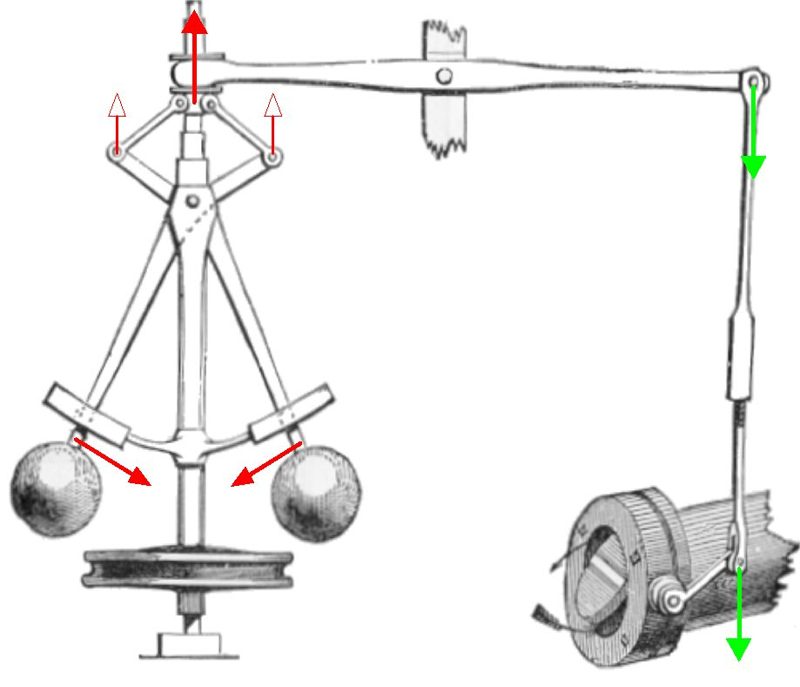
Drawing of a Watt-type centrifugal governorAfter James Watt (drawing edited by S. Wetzel), Drawing of a 1788 design. Public domain. Wikimedia Commons. Image source
James Watt adds a governor
1788 · James Watt (1736 to 1819) and Matthew Boulton (1728 to 1809)
Spinning governors were not new. Christiaan Huygens described one in the 1600s, and millers used them to adjust the gap between millstones. But in 1788, after a suggestion from his partner Matthew Boulton, James Watt adapted one to control his steam engine.
The governor has two heavy balls on arms that spin with the engine. As the engine speeds up, the balls swing outward. Linkage from the arms closes the steam valve a little, which slows the engine. When it slows, the balls drop and the valve opens.
Factory machines needed steady speed, so the governor was a big step. It was one of the last of Watt's improvements to the steam engine, and it was so important that he is sometimes wrongly called its inventor.
In control terms, the governor is a proportional controller. It cannot hold an exact speed when the load changes, so it leaves an offset. Instrument technicians still deal with that same offset today, which is why controllers add integral action.
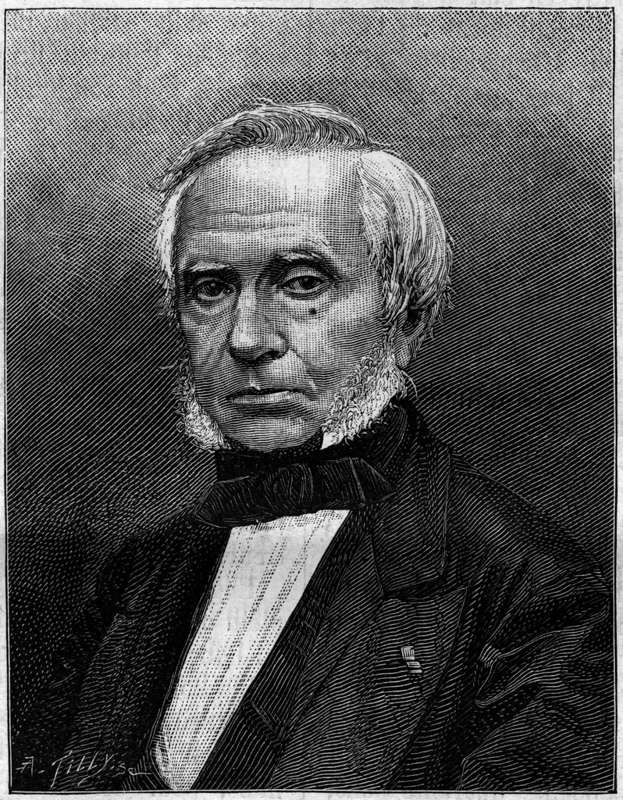
Eugène Bourdon was born in Paris in 1808, the son of a silk merchant. As a boy he loved mechanical things. After working in an optician's shop, he set up his own workshop in 1832, making scientific instruments and model steam engines.
In his day, pressure was often measured with a mercury manometer, a glass tube that was fragile and awkward. Bourdon wanted a way to measure gas pressure without mercury.
His answer was a curved metal tube, sealed at one end. When pressure inside rises, the tube tries to straighten. Linkage turns that small movement into a pointer moving across a dial. He patented the Bourdon tube gauge in Paris on 18 June 1849, and it won a gold medal at an exhibition that year.
The Bourdon gauge is still probably the best-known pressure gauge in use. The same tube also shows up inside some pressure transmitters and recorders. Every time a technician checks a gauge against a deadweight tester, Bourdon's idea is on the bench.
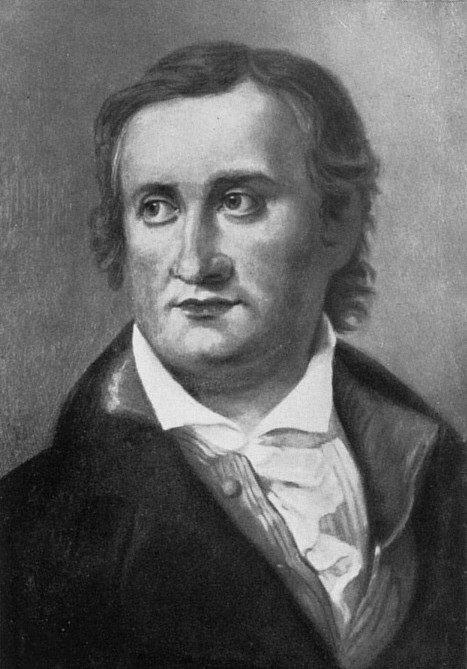
Thomas Johann Seebeck, early 1800sUnknown author, Early 19th century. Public domain. Wikimedia Commons. Image source
Thomas Seebeck and the moving needle
1821 to 1823 · Thomas Johann Seebeck (1770 to 1831)
Thomas Johann Seebeck was born in Reval, now Tallinn, Estonia, in 1770. He earned a medical degree but preferred physics. In 1820 Hans Christian Ørsted had shown that an electric current moves a compass needle, and Seebeck set out to learn more.
Between 1821 and 1823 Seebeck made circuits from two different metals joined at both ends. When one joint was hotter than the other, a nearby compass needle moved. He tried many pairs of metals and made a table of how strongly each pair moved the needle.
Seebeck thought he had found a kind of magnetism caused by heat. Others saw it differently: the temperature difference was making an electric current, and the current moved the needle. Ørsted named it the thermoelectric effect.
Today it is called the Seebeck effect. The voltage depends on the temperature difference between the two junctions. That is why a thermocouple needs a reference, or cold junction, and why the extension wire must match the thermocouple type.
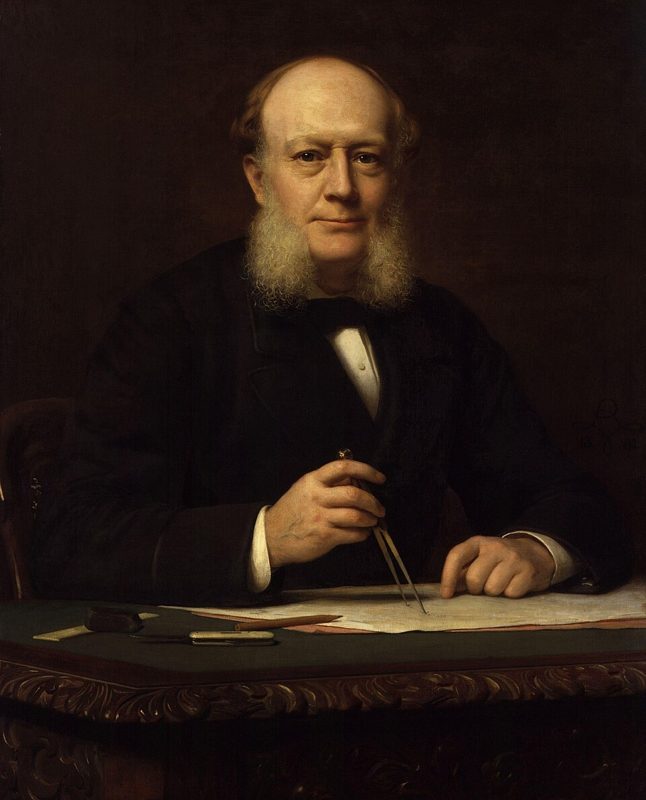
Sir William Siemens, painted by Rudolph LehmannRudolph Lehmann (died 1905), Unknown date, but author died in 1905. Public domain. Wikimedia Commons. Image source
William Siemens proposes the platinum RTD
1871 to 1885 · Sir William Siemens (1823 to 1883) and Hugh Longbourne Callendar (1863 to 1930)
Engineers knew that a metal wire's electrical resistance rises as it gets hotter. Carl Wilhelm Siemens, known in Britain as Sir William Siemens, saw that this could be used to measure temperature.
On 27 April 1871 he gave the Bakerian Lecture to the Royal Society in London. He proposed platinum wire as the sensing element. Platinum is a noble metal that does not corrode easily, and its resistance changes in a steady way over a wide range of temperatures. He wanted it for jobs like measuring furnace heat.
His first instruments were not stable enough, and the idea fell out of favour for a while. Between 1885 and 1900 Hugh Longbourne Callendar and others worked out how to build the elements properly. Callendar made the first commercially successful platinum resistance thermometer in 1885.
Today's RTDs still use platinum, often a Pt100 element that reads 100 ohms at 0 degrees Celsius. Technicians check them with a resistance source or a calibrator and watch out for lead-wire resistance, which is why many RTDs use three or four wires.
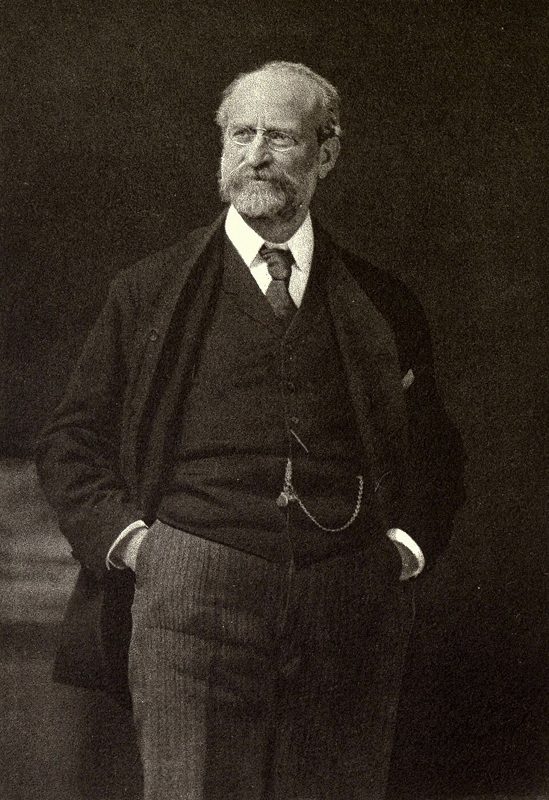
Clemens Herschel, 1906Walter G. Kent, 1906. Public domain. Wikimedia Commons. Image source
Clemens Herschel measures the water
1886 to 1888 · Clemens Herschel (1842 to 1930)
Clemens Herschel was born in Vienna in 1842 and moved to the United States as a child. He studied engineering at Harvard. Around 1880 he went to work for the Holyoke Water Power Company in Massachusetts, which sold water from a canal system to many mills.
The company needed a fair way to know how much water each mill used. Herschel ran the Holyoke Testing Flume, a lab for testing water turbines, and there he worked on the problem.
He used an effect described by the Italian physicist Giovanni Battista Venturi in 1797. When water flows through a narrowing in a pipe, it speeds up and its pressure drops. Measure the pressure before and in the throat, and you can work out the flow. Herschel first tested his meter in 1886 and named it after Venturi. His US patent was granted in 1888.
The Venturi meter was the first large, accurate device for measuring water flow. Venturi tubes, orifice plates and flow nozzles all work on the same differential pressure idea that technicians use with DP transmitters today.