Heavy duty equipment technicians keep the machines that dig, lift and haul running. Here are a few of the people behind the hydraulics, engines and tracks they work on.
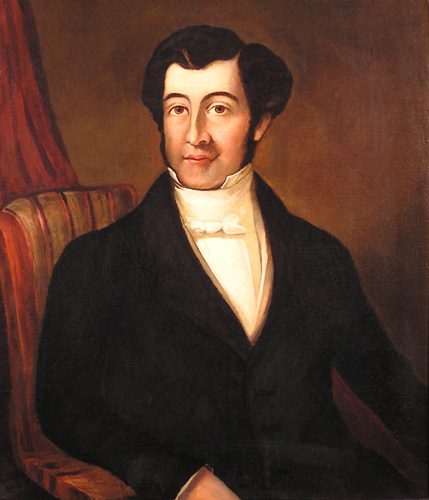
Portrait of Joseph Bramah, early 1800sArtist unknown, early 19th century. Public domain. Wikimedia Commons. Image source
Joseph Bramah's hydraulic press
1795 · Joseph Bramah (1748 to 1814)
Joseph Bramah was born on a farm in Yorkshire, England, in 1748. At 16 an ankle injury ended his farm work, so he trained with the village carpenter, then walked to London and worked as a cabinet maker. There he became one of the busiest inventors of his time. He patented a better water closet in 1778 and, in 1784, a famous lock that was very hard to pick.
In 1795 Bramah patented his hydraulic press. It put to work a rule described by the French scientist Blaise Pascal: pressure pushed into a trapped liquid spreads equally in every direction.
Bramah's press had a small pump piston and a large ram, joined by a pipe full of water. Push down on the small piston and the pressure travels to the big ram. Because the ram has much more area, it pushes with much more force. A worker on a hand lever could press, lift or bend things no person could move alone.
Some of the best mechanics of the day worked in Bramah's shop, including a young Henry Maudslay.
Every hydraulic cylinder on an excavator, loader or crane works on the same principle: a small force over a small area becomes a big force over a big one.
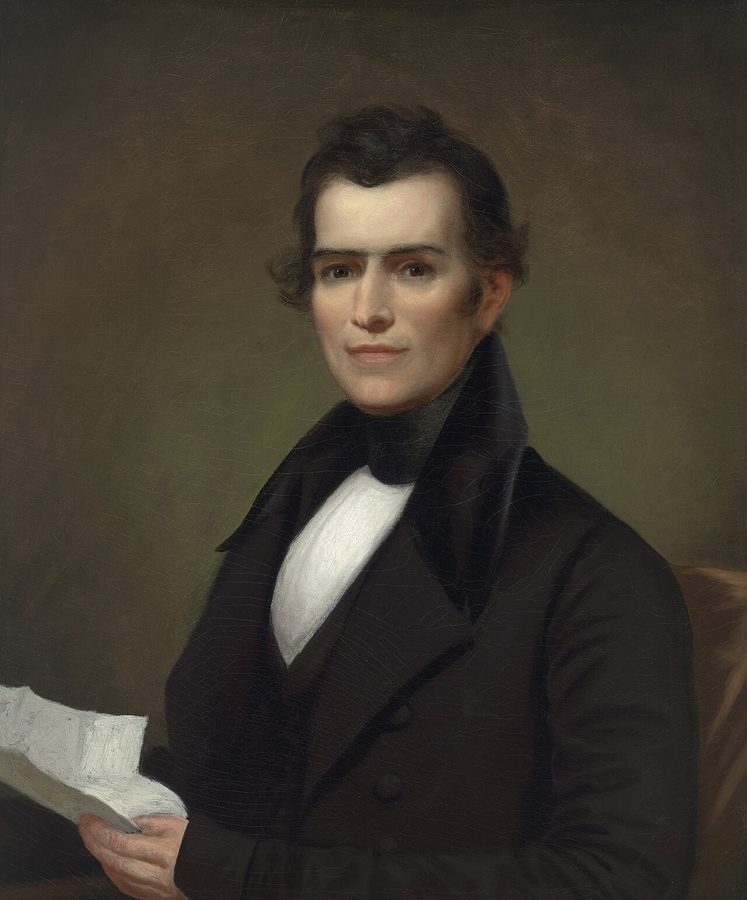
William Smith Otis, painted by Bass Otis, about 1835Bass Otis (1784 to 1861), about 1835. Public domain. Smithsonian National Portrait Gallery via Wikimedia Commons. Image source
William Otis and the steam shovel
1835 to 1839 · William Smith Otis (1813 to 1839)
In the 1830s railroads were spreading across the United States, and every mile needed cuts and fills. Most of that earth was moved by hand, with picks, shovels and carts.
William Smith Otis was in his early twenties and working on railroad construction when he built a steam-powered digging machine in 1835. A steam engine on a railway car worked a crane-like boom and a dipper, or bucket, that bit into the ground and swung the load aside. His machines were put to work on railroad building in Massachusetts.
On 24 February 1839 Otis received US patent number 1,089 for a crane excavator for digging and removing earth. Sadly, he died later that same year, at only 26.
His widow later asked to have the patent extended, and steam shovels built along the same lines went on to dig canals, mines and railways for decades.
Today Otis is in the Association of Equipment Manufacturers Hall of Fame. Every excavator with a boom, stick and bucket owes something to his idea.
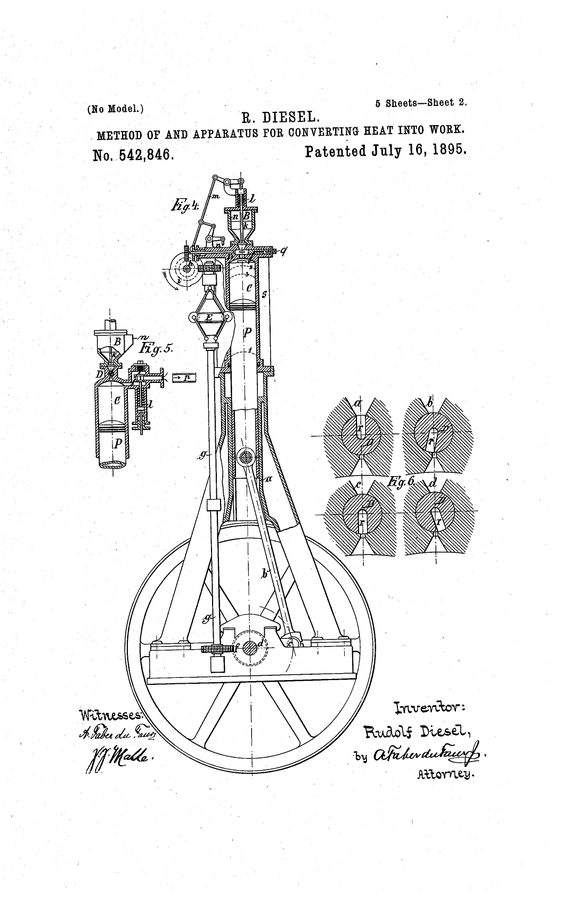
Sheet 2 of Rudolf Diesel's US patent 542,846, granted 16 July 1895Rudolf Diesel (patent drawing), 1895. Public domain (US patent drawing). United States Patent and Trademark Office via Google Patents. Image source
Rudolf Diesel's engine
1893 to 1897 · Rudolf Diesel (1858 to 1913)
Rudolf Diesel was an engineer who wanted an engine that wasted far less of its fuel than the steam engines of his day.
His idea was simple to say and hard to build. Squeeze air so hard in the cylinder that it gets hotter than the fuel's ignition point, then spray in fuel. It lights by itself. No spark plug is needed.
Diesel received his first German patent for the idea in 1893. That same year, the Maschinenfabrik Augsburg, a company later known as MAN, began building a test engine with him. The first runs were rough, and the work took years of changes.
On 17 February 1897 the engine passed its official test. It turned about 26 percent of the fuel's energy into work, far better than most engines of its time. His US patent of 1895 shows the design here.
Diesel died in 1913, but his engine took over. Today almost every bulldozer, loader, haul truck and grader runs on a diesel, and technicians still talk about compression ignition every day.
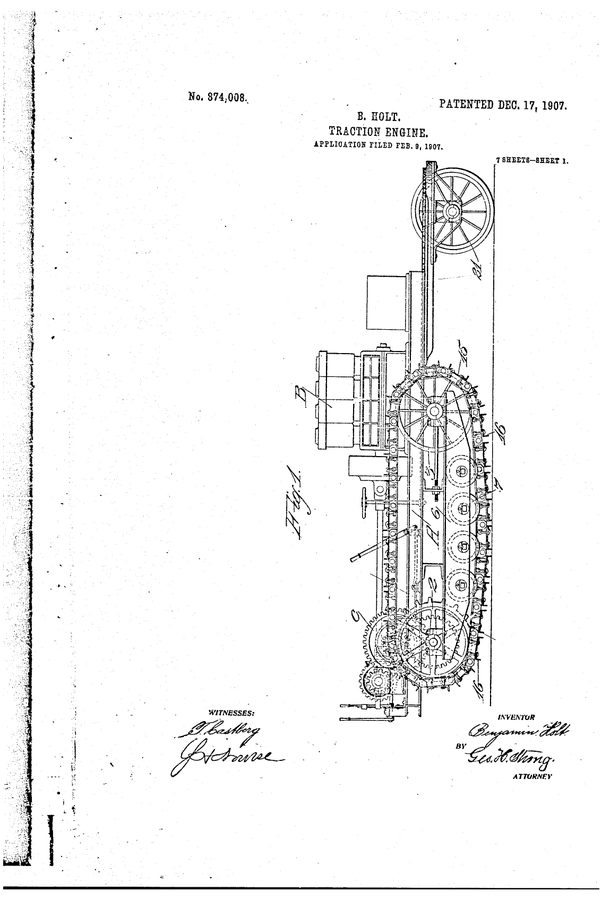
Drawing from Benjamin Holt's US patent 874,008, traction engine, granted 17 December 1907Benjamin Holt (patent drawing), 1907. Public domain (US patent drawing). United States Patent and Trademark Office via Google Patents. Image source
Benjamin Holt puts a tractor on tracks
1904 to 1925 · Benjamin Holt (1849 to 1920) and C. L. Best
Near Stockton, California, the rich delta farmland was soft and peaty. Heavy steam tractors on wheels sank into it, no matter how wide the wheels were made.
Benjamin Holt ran a company in Stockton that built harvesters and steam tractors. His answer was to take the wheels off. On 24 November 1904 his team tested a Holt steam tractor fitted with tracks made of wooden blocks on chains. The tracks spread the weight over a much bigger area, and the machine worked the soft ground that had stopped wheeled tractors.
Holt kept improving the idea and patented a track-laying traction engine in 1907, the drawing shown here. In 1910 he registered the name Caterpillar as a trademark.
In 1925 Holt's company merged with its rival, the C. L. Best Tractor Company, to form the Caterpillar Tractor Company.
The track-type tractor is now a landmark recognised by engineering societies. Every dozer, crawler excavator and track loader you service carries on Holt's idea of spreading the load.
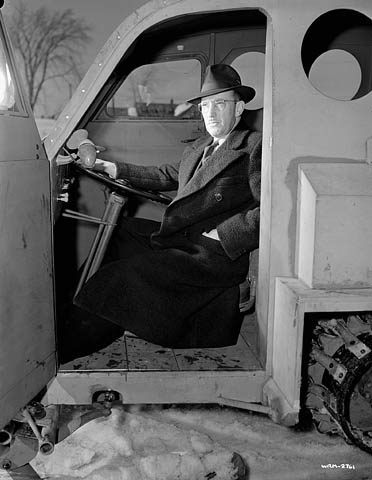
Joseph-Armand Bombardier, March 1943Photographer unknown, 1943. Public domain (Canadian photograph taken before 1949). Library and Archives Canada via Wikimedia Commons. Image source
Armand Bombardier drives over the snow
1937 to 1959 · Joseph-Armand Bombardier (1907 to 1964)
In rural Quebec in the 1930s, snow closed many roads for months. Joseph-Armand Bombardier, born in Valcourt in 1907, ran a garage there and spent years trying to build a machine that could travel over deep snow.
His breakthrough was the drive system. A sprocket wheel turned a track made with rubber, which gripped the snow without clogging. Bombardier received a Canadian patent for his sprocket and track system on 29 June 1937.
That year he began building the B7, a closed snowmobile that carried seven people. Country doctors, priests, mail carriers and businesses bought them to get around in winter. In 1942 he founded L'Auto-Neige Bombardier Limitée and built the larger B12, which carried twelve.
In 1959 his company began selling a small one- or two-person machine for recreation, the Ski-Doo. It started a whole new sport.
Bombardier died in 1964. His work in Valcourt grew into big Canadian companies, and today the J. Armand Bombardier Museum there tells his story. Anyone who works on tracked equipment in snow country is following in his tracks.