Hairstylists blend skill, chemistry and care for people. Here are a few of the people who built the trade, from the first salon chains to the first permanent waves.
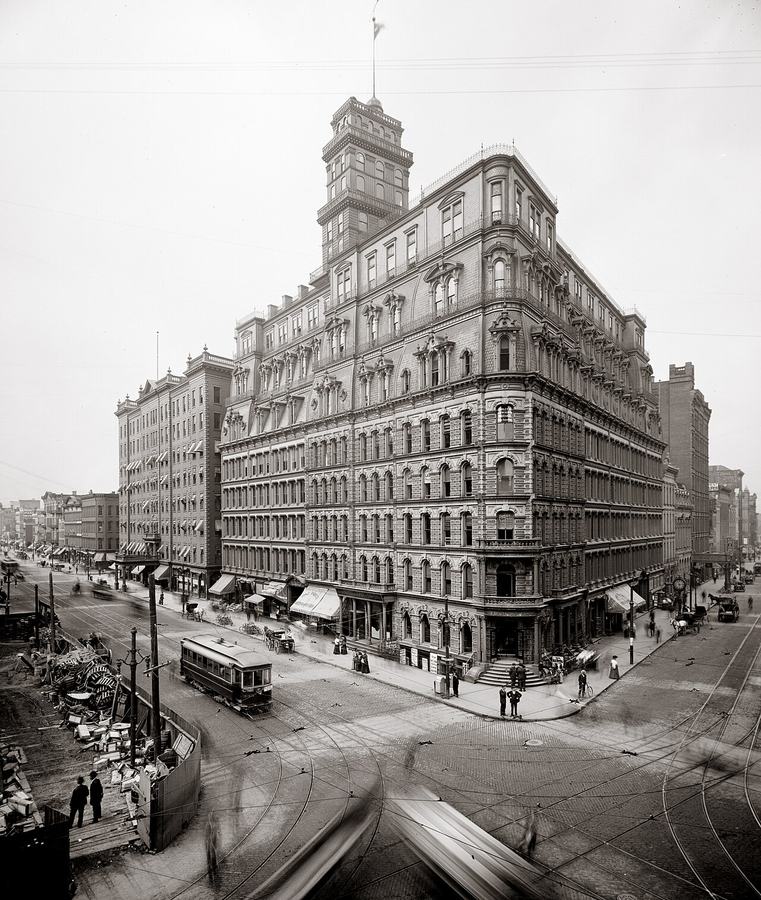
The Powers Building, Rochester, New York, about 1904, where Harper opened her first salonDetroit Publishing Company, about 1904. Public domain (no known copyright restrictions). Library of Congress (det.4a12118) via Wikimedia Commons. Image source
Martha Matilda Harper opens her shop
1888 to 1891 · Martha Matilda Harper (1857 to 1950)
Martha Matilda Harper was born in 1857 at Munn's Corners, near Oakville, Ontario. At seven she was sent out to work as a household servant. She stayed in service for many years, first in Canada and then in Rochester, New York, where she moved in 1882.
Along the way she became convinced that healthy hair starts with a healthy scalp. In 1888 she used her savings of 360 dollars to open a beauty salon for women in Rochester's Powers Building, shown here. Her Harper Method focused on clean, healthy hair and scalp care, with massage and gentle natural products.
Clients came from far away and asked for shops in their own cities. In 1891 the first Harper Method shop opened in Buffalo, run by a woman Harper had trained. Each shop was owned by its operator, who followed Harper's methods and used her products.
The network grew to more than 500 shops around the world. Business historians now point to it as one of the earliest franchise systems.
Harper gave many working women the chance to own a business of their own.
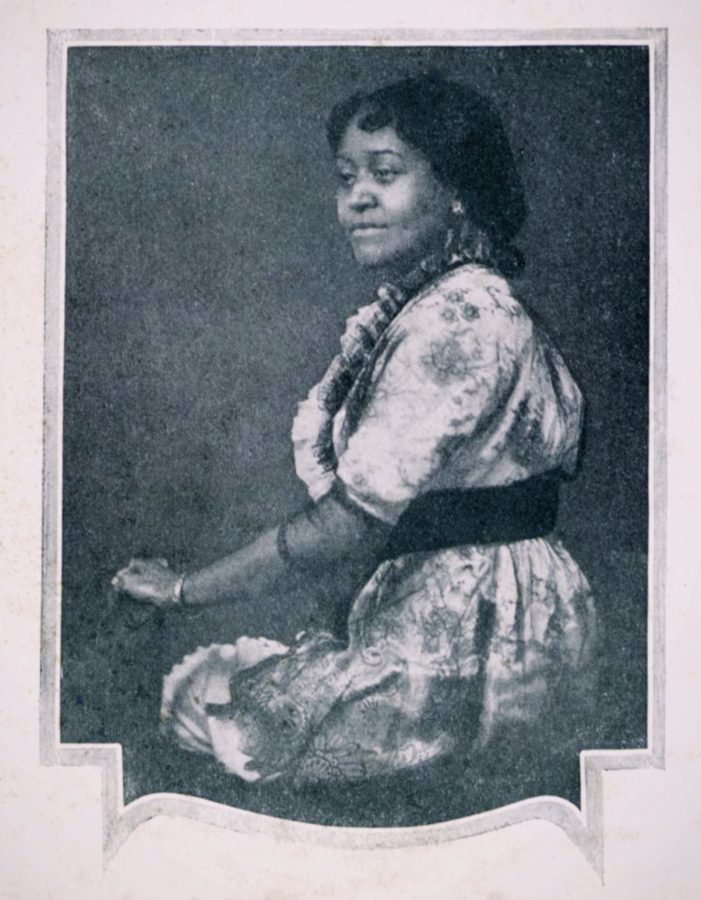
Annie Turnbo Malone, from a Poro College souvenir booklet (1920s)Poro College Company, St. Louis, about 1920. Public domain. Smithsonian National Museum of African American History and Culture via Wikimedia Commons. Image source
Annie Malone builds Poro College
1900 to 1918 · Annie Turnbo Malone (1869 to 1957)
Annie Turnbo was born in 1869 in Metropolis, Illinois. She loved chemistry in school, and around 1900 she began making her own hair and scalp products for Black women.
In 1902 she moved her business to St. Louis, Missouri. She and her helpers sold the products door to door and showed customers how to use them. In 1906 she registered the name Poro for her products and her system of hair care.
Malone's big idea was training. She taught women to become Poro agents, who sold the products and passed on the methods, and many earned their own income. In 1918 she opened Poro College in St. Louis, a large building with classrooms, a factory, offices and meeting halls. It trained students in hair culture and became a centre of the city's Black community.
Malone gave generously, especially to the St. Louis Colored Orphans' Home. It was renamed the Annie Malone Children's Home in 1946, and it still carries her name today.
She helped show that hair care could be a respected profession and a path to independence.
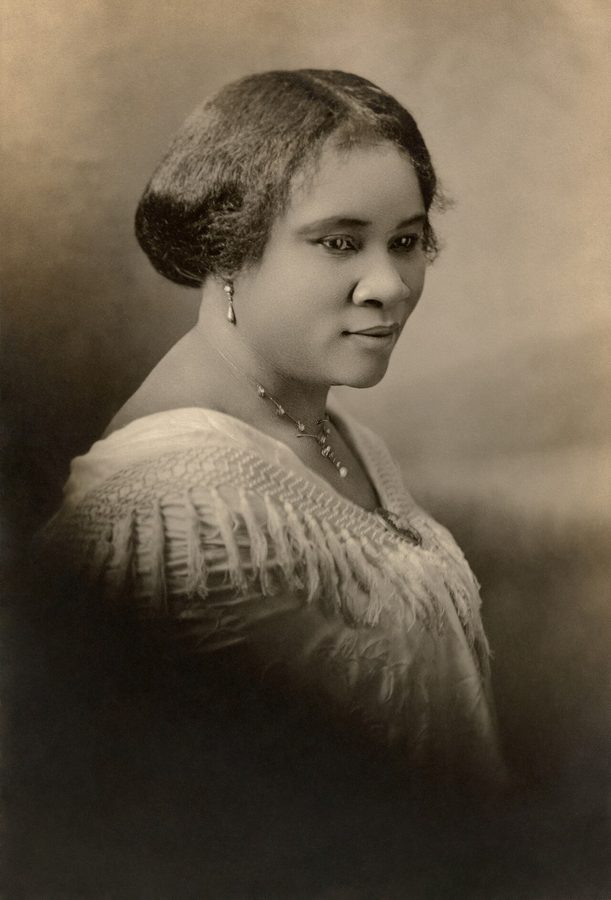
Madam C. J. Walker, photographed by Addison N. Scurlock, about 1914Addison N. Scurlock (1883 to 1964), about 1914. Public domain. Smithsonian National Portrait Gallery via Wikimedia Commons. Image source
Madam C. J. Walker trains the culturists
1905 to 1919 · Madam C. J. Walker (Sarah Breedlove, 1867 to 1919)
Sarah Breedlove was born in 1867 on a plantation in Delta, Louisiana, the first child in her family born into freedom. She was orphaned young and later worked for years as a washerwoman. Like many women then, she suffered from scalp problems and hair loss.
She worked as a sales agent for Annie Turnbo Malone's products, and in 1905 she moved to Denver, where she began making her own scalp treatment. After marrying Charles Joseph Walker in 1906, she called herself Madam C. J. Walker and travelled widely selling her products and demonstrating her Walker system.
Walker believed in training. In 1908 she opened Lelia College in Pittsburgh to teach hair culturists. In 1910 she moved her headquarters to Indianapolis, with a factory, a laboratory, a salon and a beauty school. Thousands of women became Walker agents and earned their own income.
She gave money to schools, the YMCA and civil rights causes, and encouraged her agents to give back to their communities too.
Walker died in 1919. She is remembered as one of the most successful businesswomen of her time.
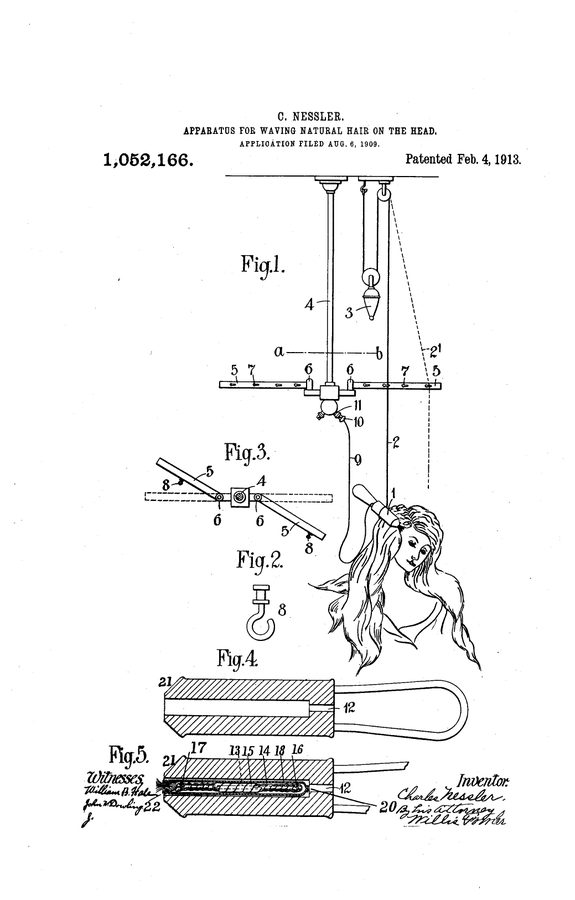
Drawing from Charles Nessler's US patent 1,052,166, apparatus for waving natural hair on the head, granted 4 February 1913Charles (Karl) Nessler (patent drawing), 1913. Public domain (US patent drawing). United States Patent and Trademark Office via Google Patents. Image source
Karl Nessler's permanent wave
1906 to 1913 · Karl Ludwig Nessler, also known as Charles Nestle (1872 to 1951)
For centuries, curls only lasted until the hair got wet. Hot tongs gave a wave for a day or two, and then it was gone.
Karl Ludwig Nessler was born in 1872 in Todtnau, in Germany's Black Forest, and trained as a hairdresser. He settled in London and ran a salon on Oxford Street, where he called himself Charles Nestle.
He worked for years on a way to make curls last. His method wound sections of hair around rods, coated them with an alkaline paste, and heated them with hot metal tubes hung from a stand. The heat and the chemistry changed the hair so the curl stayed through washing.
On 8 October 1906 Nessler showed his process to hairdressers at his London salon. Early versions were slow, heavy and hot, and took hours. He kept improving it and took out patents in Britain and the United States, including the US patent shown here, granted in 1913.
In 1915 Nessler moved to New York, where his permanent wave business grew. Today's perms use gentler chemistry and no hot tubes, but the idea of reshaping the hair's inner bonds goes back to his work.
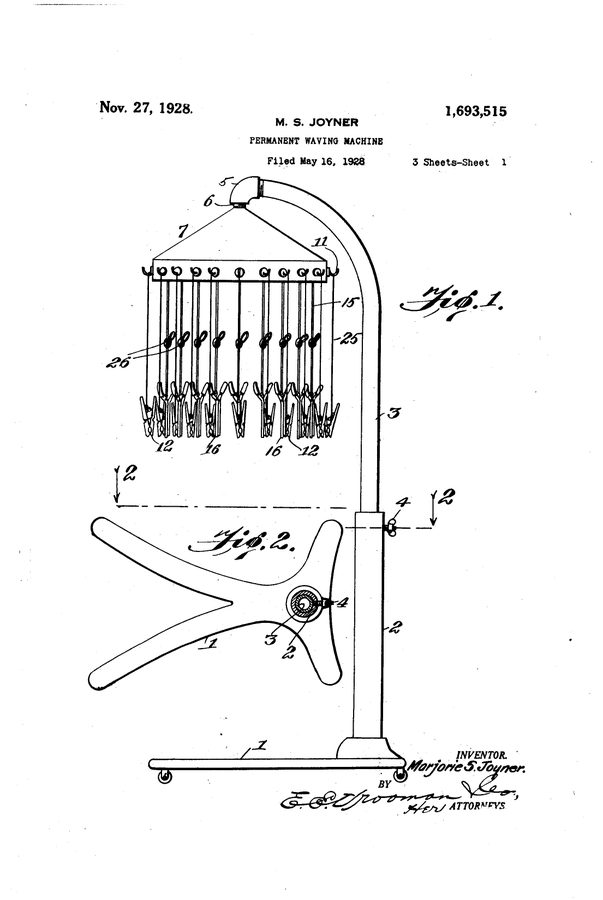
Drawing from Marjorie S. Joyner's US patent 1,693,515, permanent waving machine, granted 27 November 1928Marjorie S. Joyner (patent drawing), 1928. Public domain (US patent drawing). United States Patent and Trademark Office via Google Patents. Image source
Marjorie Joyner's waving machine
1916 to 1928 · Marjorie Stewart Joyner (1896 to 1994)
Marjorie Stewart Joyner grew up in Virginia and moved to Chicago as a young woman. In 1916 she became the first African American graduate of the A. B. Molar Beauty School there and opened her own salon.
She soon met Madam C. J. Walker and went to work for the Walker company. She rose to become national supervisor of its beauty schools, helping train thousands of Walker stylists over the years.
Permanent waves in the 1920s took a long time, and stylists had to set many curls one at a time. Joyner designed a machine with a hood of many rods, each heated by electricity, that could wave a whole head of hair at once. She filed for a patent in May 1928, and US patent 1,693,515 for her permanent waving machine was granted on 27 November 1928. The patent was assigned to the Walker company.
Joyner kept teaching for decades and worked to raise standards for the beauty trade.
Her story shows how a stylist's know-how at the chair can turn into a real invention.