Electricians work with forces that scientists only began to understand in the 1700s and 1800s. Here are a few of the people who turned those discoveries into wiring and power.
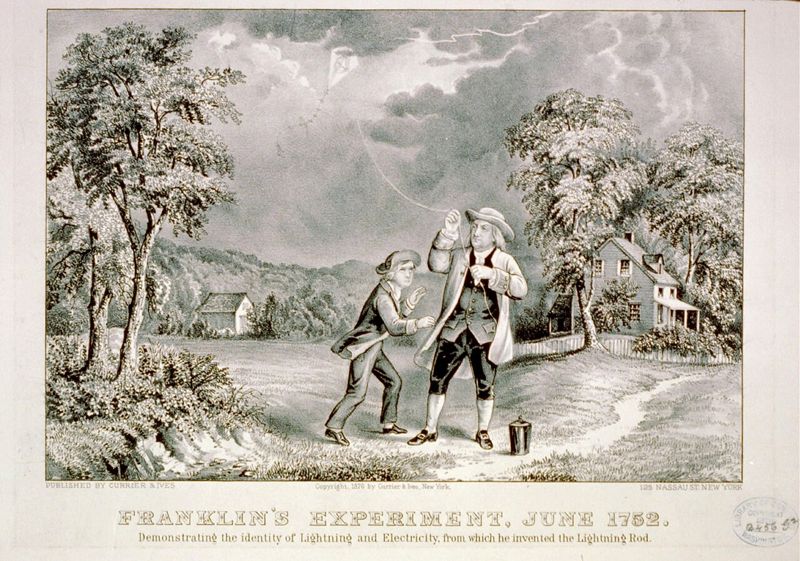
Franklin's kite experiment as imagined in an 1876 printCurrier and Ives, New York, 1876. Public domain. Pennsylvania State University via Wikimedia Commons. Image source
Benjamin Franklin and the lightning rod
1750 to 1753 · Benjamin Franklin (1706 to 1790) and the French naturalist Thomas-François Dalibard
In the late 1740s Benjamin Franklin, a Philadelphia printer, spent his spare time experimenting with electricity alongside friends. He noticed that sharp metal points drew off electric charge quietly and from a distance, much better than blunt ones.
In a 1750 letter to Peter Collinson in London he made two suggestions. A tall, insulated iron rod could test whether storm clouds carry electricity. And a pointed rod, joined by a wire running down into the ground, might protect a building from lightning. Collinson published Franklin's letters in 1751.
In France, the naturalist Thomas-François Dalibard tried the first idea. On 10 May 1752, at Marly-la-Ville near Paris, a helper drew sparks from a tall insulated rod as a storm passed. Lightning really was electricity. By Franklin's own account he drew sparks from a key on a kite string in June 1752, before news from France reached him; that is the scene in the picture, drawn more than a century later.
Franklin then turned the idea into practical advice. In Poor Richard's Almanack for 1753 he told readers to fix an iron rod with a sharp point above the roof, run it three or four feet into moist ground, and fasten it with a few staples. Air terminal, down conductor, ground: the same parts you still see in lightning protection today.
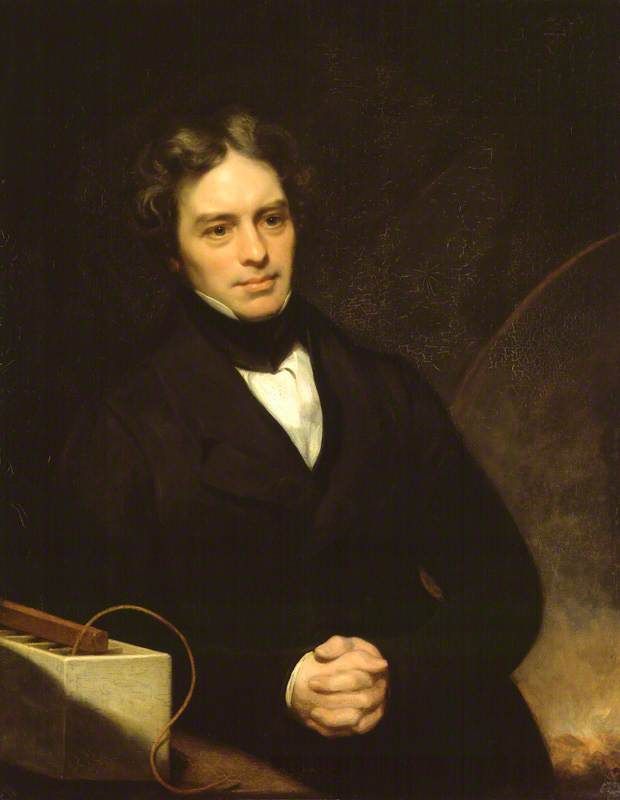
Michael Faraday, painted by Thomas Phillips in 1841 to 1842Thomas Phillips, 1841 to 1842. Public domain. National Portrait Gallery, London (NPG 269) via Wikimedia Commons. Image source
Michael Faraday makes current from magnetism
1831 · Michael Faraday (1791 to 1867)
By the 1820s scientists knew that an electric current could make a magnet. Michael Faraday, working at the Royal Institution in London, wanted to know whether a magnet could make a current.
On 29 August 1831, in the Royal Institution's basement laboratory, he wound two separate coils of cotton-covered copper wire onto an iron ring. One coil went to a battery and the other to a meter that detected current. When he connected or disconnected the battery, the needle jumped. Changing magnetism in the ring was pushing current through the second coil, even though the two coils never touched.
That ring is the first electric transformer, and the original is still at the Royal Institution. A few weeks later, in October 1831, Faraday showed that simply moving a bar magnet in and out of a coil of wire produced a current too. That was the first electric generator: motion plus magnetism makes electricity.
Faraday called the effect electromagnetic induction. Every transformer on a pole, every generator in a power station and every motor you wire still depends on it. Faraday had little formal schooling. He began as a bookbinder's apprentice before becoming an assistant at the Royal Institution, and he went on to become one of the great experimental scientists.
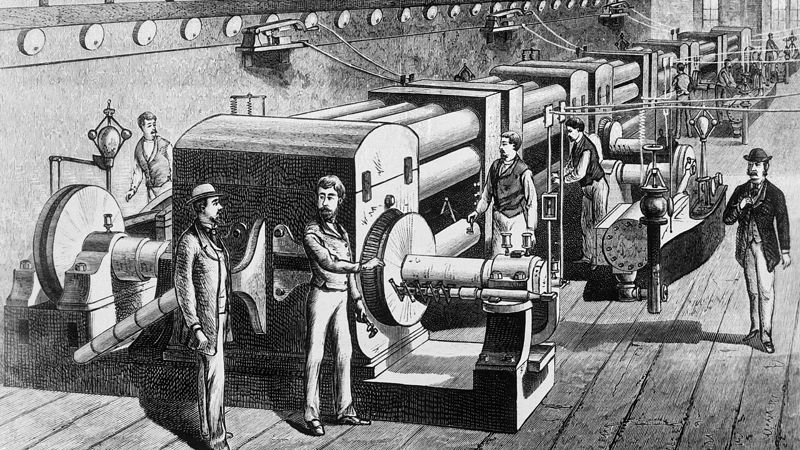
Edison's Pearl Street station, New York, about 1885Unknown photographer, About 1885. Public domain. Deutsches Museum picture archive via Wikimedia Commons. Image source
Edison switches on Pearl Street
1882 · Thomas Edison (1847 to 1931) and his chief electrician, John W. Lieb
Thomas Edison's light bulb of 1879 was only half the job. To sell electric light, he needed a whole system: generators, underground cables, fuses, switches, meters and fixtures. In 1880 he set up the Edison Electric Illuminating Company of New York to build it.
He bought two buildings at 255 and 257 Pearl Street in lower Manhattan and strengthened the floors to carry six huge dynamos. Each was nicknamed Jumbo, after a famous circus elephant. They were driven by steam engines fed from coal-fired boilers. Out in the streets, crews laid about 80,000 feet of underground conductors to serve the First District, an area of about a quarter of a square mile.
On the afternoon of 4 September 1882, Edison gave the signal and chief electrician John W. Lieb closed the switch. The station could feed about 7,200 lamps, but on the first day it lit about 400 lamps for some 85 customers, including The New York Times.
Pearl Street ran on direct current at low voltage, so it could only serve customers close by. Alternating current would soon take over long-distance supply. Still, Pearl Street was the first permanent central station of its kind in the United States, and the pattern of a central plant, a distribution network and metered customers is the one the electrical trade still works in.
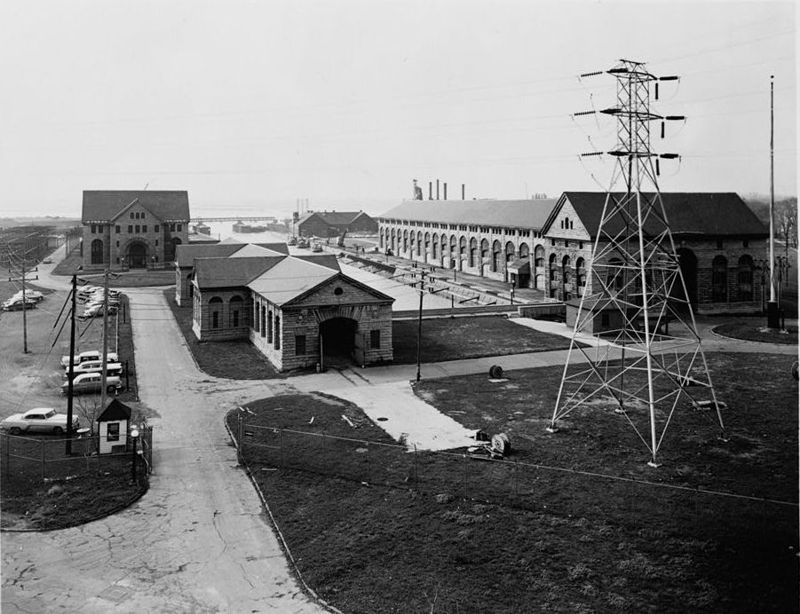
Adams power plant, Niagara Falls, photographed for the Historic American Buildings Survey in 1941Historic American Buildings Survey, 1941. Public domain. Library of Congress (HABS NY-1014) via Wikimedia Commons. Image source
Niagara Falls lights up the grid
1895 to 1896 · Nikola Tesla (1856 to 1943), George Westinghouse (1846 to 1914) and the Niagara Falls Power Company
By the 1890s engineers knew Niagara Falls held enormous power. The question was how to get it to the cities that wanted it. Direct current at low voltage could not travel far. Alternating current could be stepped up to a high voltage with transformers, sent a long way, then stepped back down.
The Niagara Falls Power Company chose alternating current. Westinghouse Electric built the first generators, each rated at 5,000 horsepower, producing two-phase current at 25 cycles. Their nameplates listed patents held by Nikola Tesla, whose polyphase AC system made them possible.
The Adams plant began supplying power to local industry on 26 August 1895. Just after midnight on 16 November 1896, power began flowing to Buffalo, more than 20 miles away. Transformers raised the voltage from 2,200 to 11,000 volts for the line, then lowered it again in Buffalo, where much of it ran the electric streetcars.
By 1900 the plant had ten of the 5,000 horsepower generators. The IEEE calls its opening a key victory for alternating current. Generator number one survives in the Smithsonian's National Museum of American History. The system that electricians work on today, with large generating plants, high-voltage lines and local distribution, took shape here.
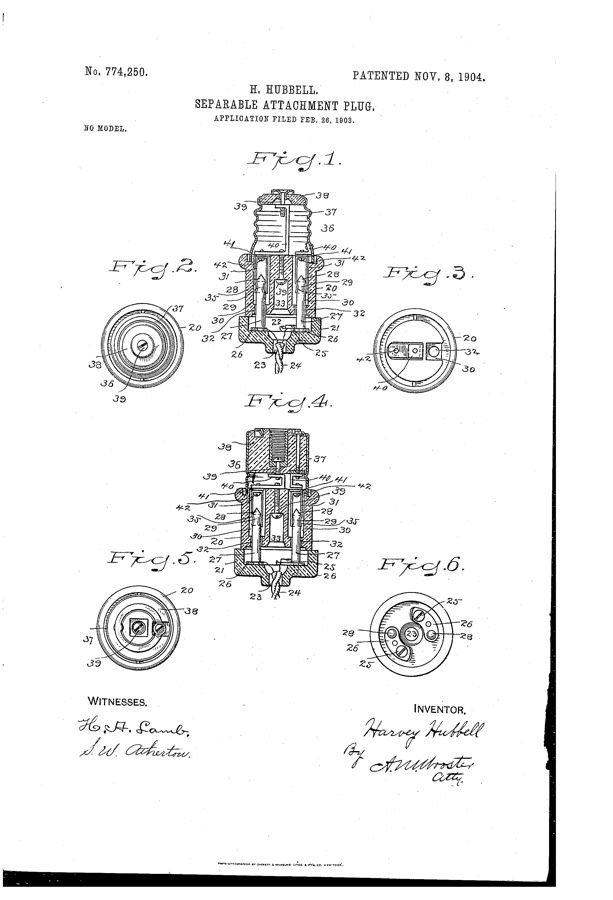
Drawing from Harvey Hubbell's US patent 774,250, granted 8 November 1904Harvey Hubbell (patent drawing), 1904. Public domain (US patent drawing). United States Patent and Trademark Office via Google Patents. Image source
Harvey Hubbell unplugs the house
1888 to 1904 · Harvey Hubbell II, Bridgeport inventor and manufacturer
Around 1900, plugging something in was not an option. Electric devices were usually hardwired to terminals coming out of a wall or a light socket. Moving an appliance meant undoing wires, and getting them wrong could cause a short circuit.
Harvey Hubbell was an inventor and manufacturer in Bridgeport, Connecticut. He opened the Harvey Hubbell company there in 1888, and in 1896 he patented a pull-chain light socket, still a familiar fitting in basements and closets.
In February 1903 he applied for a patent on a separable attachment plug. It had two parts. One screwed into an ordinary lamp socket and stayed there. The other was fixed to the end of the appliance cord. The two halves pushed together and pulled apart, so a device could be connected or disconnected safely without tools. US patent 774,250 was granted on 8 November 1904.
Hubbell's company went on to patent many more wiring devices, and the idea of a cord that plugs into a fixed outlet became normal. Every time you install a receptacle, you are wiring the other half of his idea.