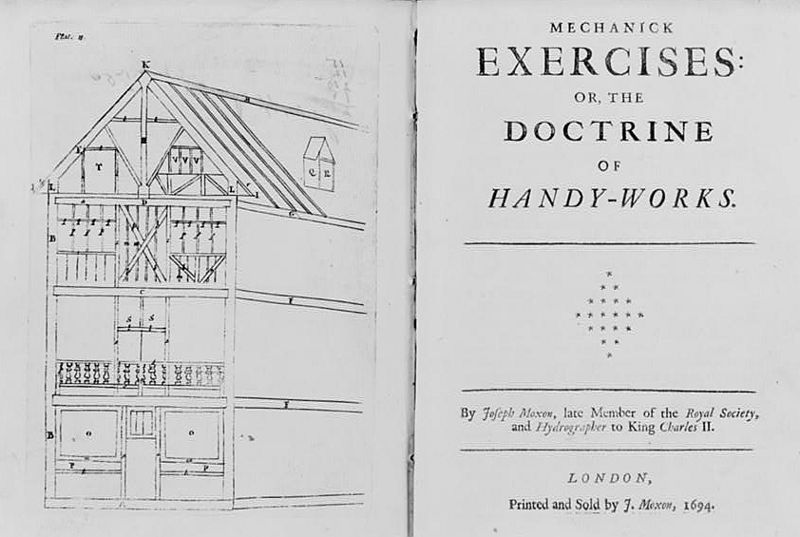
Frontispiece and title page of Mechanick Exercises, 1694 editionJoseph Moxon (author), engraver unknown, 1694. Public domain. Library of Congress (cph.3c10462) via Wikimedia Commons. Image source
Joseph Moxon writes the trade down
1678 to 1680 · Joseph Moxon (1627 to 1691)
In the 1670s most carpenters learned the trade the way many still do: from a master, on the job. Very little about the hand trades had been written down in English. Joseph Moxon, a London printer who also cut type and made globes and instruments, set out to change that.
In January 1678 he began publishing Mechanick Exercises, or the Doctrine of Handy-Works in monthly parts, a bit like a magazine. Publication slowed after the first six parts, and the run finished in 1680 with fourteen numbers. Together they covered smithing, joinery, house carpentry and turning.
Each part named the tools of the trade, explained how to set them up and use them, and showed them in engraved plates. Moxon wrote down the words working tradesmen actually used, so the book is still one of the best records of how woodworkers spoke and worked in the late 1600s.
Moxon then turned to his own trade. In 1683 and 1684 he issued Mechanick Exercises on the Whole Art of Printing, a detailed guide to his own trade. The whole work was reprinted in later editions, including the one pictured here, and it is still read by woodworkers and historians today.
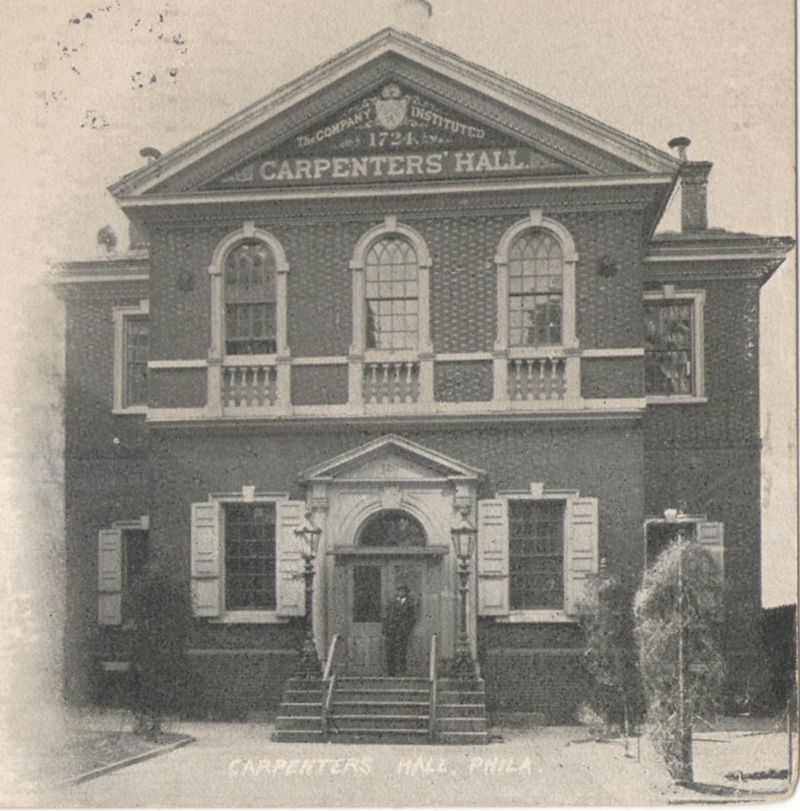
Carpenters' Hall, Philadelphia, on a postcard mailed in 1905Unknown postcard publisher, 1905 or earlier. Public domain. Wikimedia Commons. Image source
Carpenters build a hall for a new nation
1724 to 1774 · Robert Smith (about 1722 to 1777) and the Carpenters' Company of Philadelphia
In 1724 a group of master builders in Philadelphia formed the Carpenters' Company of the City and County of Philadelphia. Like the old craft guilds of London, it helped members share building knowledge and agree on fair prices for their work.
By 1770 the Company was ready to build a home of its own. Robert Smith, a carpenter and architect who was one of its members, designed the building and served as its master builder. Building began in February 1770. The hall is a Georgian building with brick walls laid in Flemish bond. The members held their first meeting in the unfinished hall on 21 January 1771, while work went on until 1774.
That same year the hall found a bigger purpose. In September 1774 delegates from the American colonies met in the newly finished hall as the First Continental Congress, to answer the British Parliament's harsh new laws against Massachusetts. The tradesmen's hall became a meeting place for a nation that did not exist yet.
The Carpenters' Company still owns and runs the hall today, and describes itself as the oldest trade guild still at work in North America. Next time you lay out a building, remember that working carpenters designed and built one of the landmarks of American history.
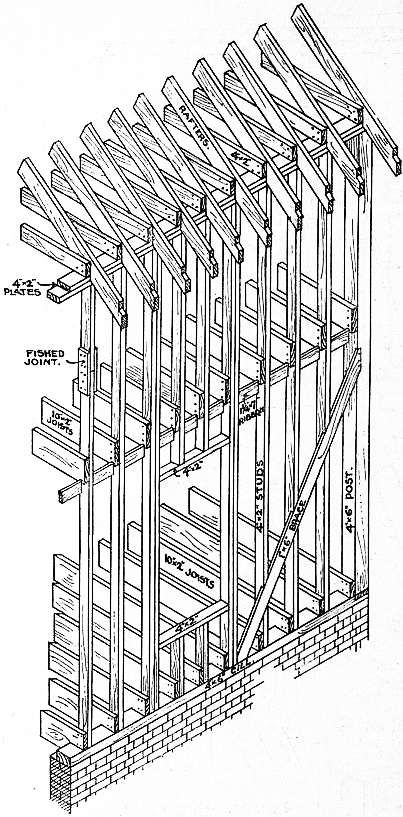
Balloon frame, from the 1911 Encyclopaedia Britannica article on carpentryHugh Chisholm (ed.), Encyclopaedia Britannica, 1911. Public domain. Wikimedia Commons. Image source
Chicago and the balloon frame
1830s to 1840s · Augustine Deodat Taylor (1796 to 1891) and George Washington Snow (1797 to 1870)
For centuries, carpenters framed buildings with heavy timbers joined by mortise and tenon. It was strong, but it took skilled joiners, big logs and a lot of time.
In the 1830s a different method took hold in the fast-growing town of Chicago. Builders used many light, sawn studs and joists, set close together, and simply nailed them in place. Machine-made nails had become cheap, and sawmills could turn out standard lumber. A small crew could now raise a building in days. It became known as the balloon frame. Its studs ran in long, light pieces from the sill all the way up to the roof.
Who came up with it is still debated. Historians agree that carpenter Augustine Deodat Taylor built St. Mary's Church in Chicago in 1833 using light framing. Other writers have credited the merchant and builder George Washington Snow, possibly with a warehouse in 1832, though some historians treat that claim as unproven. Builders elsewhere may have been working the same way.
By 1846 farm writer Solon Robinson was describing balloon framing in print for builders across the country. Platform framing, where each storey is built on its own floor deck, later replaced it. But the idea of light, nailed, repeatable framing came from the balloon frame.
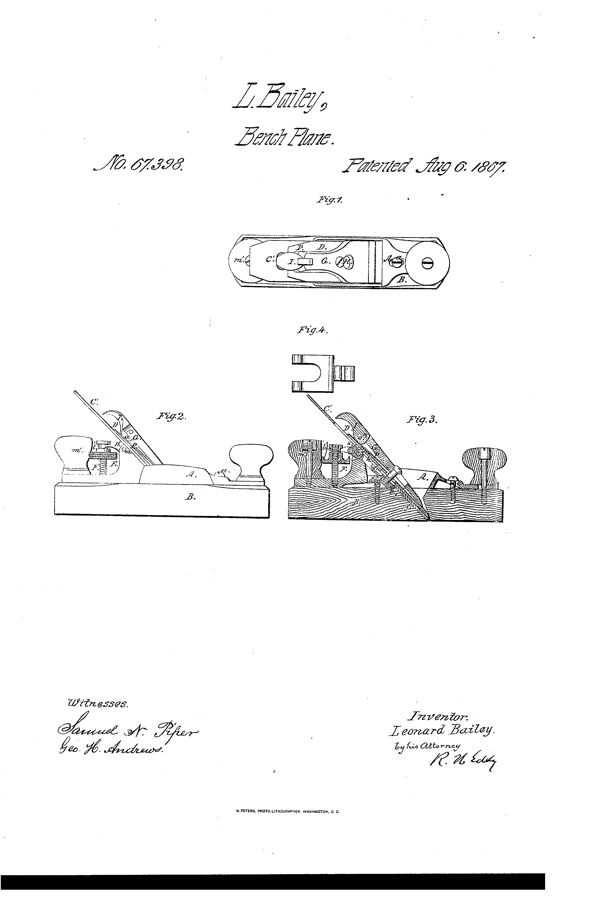
Drawing from Leonard Bailey's US patent 67,398, granted 6 August 1867Leonard Bailey (patent drawing), 1867. Public domain (US patent drawing). United States Patent and Trademark Office via Google Patents. Image source
Leonard Bailey and the adjustable plane
1858 to 1869 · Leonard Bailey (1825 to 1905)
Before the 1860s, setting a plane meant tapping the iron and wedge with a hammer until the cut looked right. Leonard Bailey thought a plane should be easier to set, and should hold its setting.
Bailey made tools in Boston. In 1858 he patented a cammed lever cap, a small lever that clamps the iron down with a flip instead of a hammered wedge. On 6 August 1867 he patented a bench plane with a screw adjustment for the depth of cut, and on 24 December 1867 another patent improved the plane's double iron and cap.
These ideas worked together. A woodworker could clamp the iron with the lever cap, then turn a brass nut to move the iron finer or coarser without hammering anything. It made planes quicker to set and more consistent from tool to tool.
In May 1869 the Stanley Rule and Level Company of New Britain, Connecticut, took a licence to Bailey's patents and began making his planes. Bailey worked with Stanley for a few years before going his own way. Stanley kept making Bailey-pattern planes for well over a century, and most metal bench planes sold today still follow his layout. Bailey died in 1905.
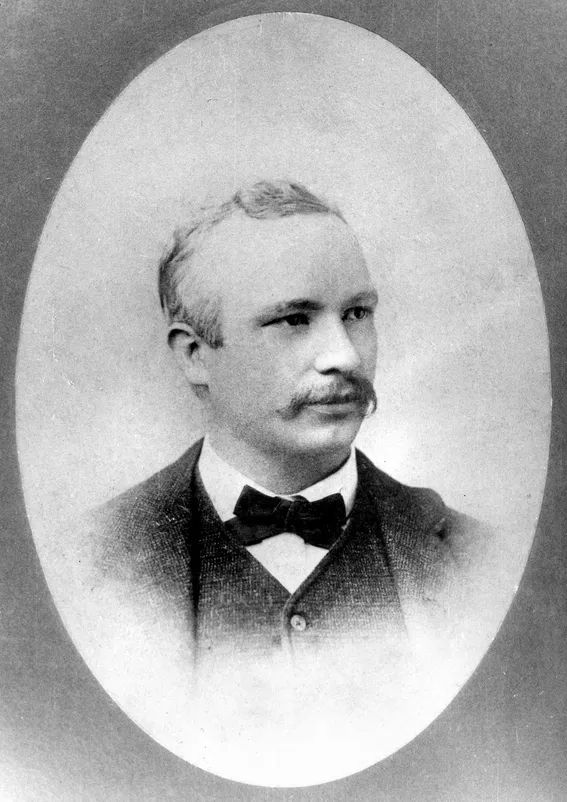
Peter J. McGuireUnknown photographer, Before 1906. Public domain. Wikimedia Commons. Image source
Peter J. McGuire organises the carpenters
1881 to 1906 · Peter J. McGuire (1852 to 1906)
Peter J. McGuire was born in New York City in 1852, the son of immigrants. He worked as a carpenter, and long days for low pay convinced him that tradesmen needed to stand together.
In August 1881 McGuire brought 36 delegates from 11 cities to a convention in Chicago, where they founded the Brotherhood of Carpenters and Joiners of America. The word United was added to its name in 1888. As general secretary for many years, McGuire built it into the largest trade union of its time.
McGuire also worked with Samuel Gompers to found the American Federation of Labor. Through the carpenters and the federation he led the big strikes of 1886 and 1890 that put the eight-hour workday on the national agenda.
He is also linked to Labor Day. The first Labor Day parade was held in New York City on 5 September 1882. McGuire has long been credited with proposing the holiday, but the US Department of Labor notes that some historians credit Matthew Maguire, a machinist, instead. Both men were active in the labour movement in New York at the time.
McGuire died in 1906. In 2004 he was named to the US Department of Labor's Hall of Honor. His union is still known today as the United Brotherhood of Carpenters.